
Anúncios
Nature’s most elegant mathematical secret lies hidden in the spiraling curves of seashells, revealing timeless patterns that connect beauty with numerical precision. ✨
Anúncios
When you hold a nautilus shell or observe a snail’s protective home, you’re witnessing one of nature’s most profound mathematical expressions. These spiral shells aren’t random formations—they embody precise mathematical relationships that have fascinated scientists, mathematicians, and artists for centuries. The connection between spiral shells, Fibonacci sequences, and the golden ratio represents one of the most beautiful intersections of mathematics and natural design.
Throughout this exploration, we’ll uncover how these mathematical principles govern not just seashells, but countless natural phenomena around us. From the arrangement of flower petals to the structure of galaxies, these same patterns repeat themselves across scales, demonstrating the underlying mathematical order of our universe.
🐚 The Mathematical Blueprint Behind Spiral Shells
Anúncios
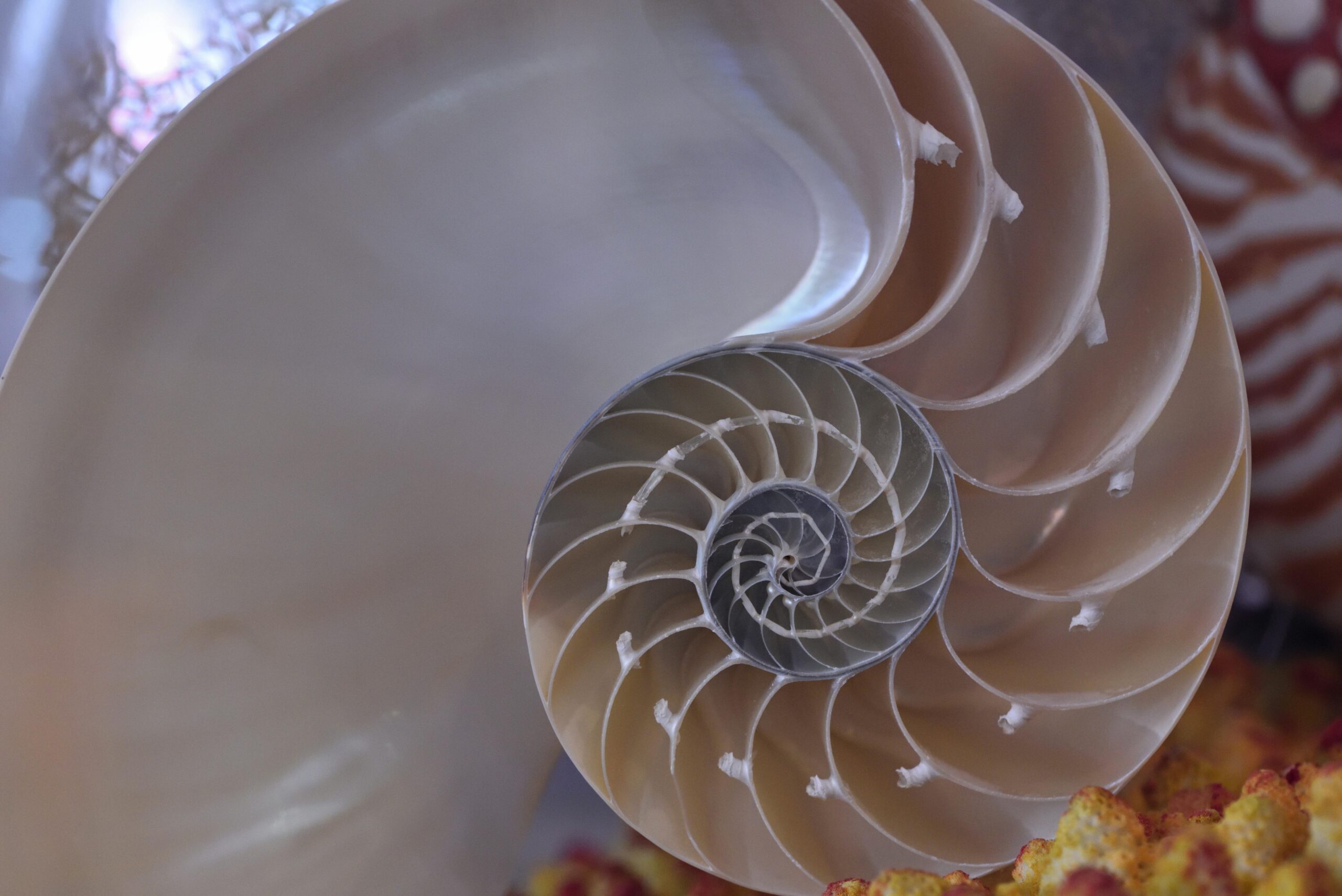
Spiral shells follow what mathematicians call a logarithmic spiral, also known as an equiangular spiral. Unlike regular spirals that maintain constant distances between turns, logarithmic spirals expand at consistent rates, creating the elegant curves we observe in nature. This mathematical form allows shells to grow while maintaining their proportional shape—a crucial survival advantage for the creatures inside.
The beauty of logarithmic spirals lies in their self-similarity. As the shell grows outward, each new chamber or whorl maintains the same proportional relationship to its predecessor. This means a tiny portion of the shell contains the same geometric information as the entire structure—a property that mathematicians call scale invariance.
Jakob Bernoulli, a 17th-century Swiss mathematician, was so enchanted by this spiral’s properties that he called it “spira mirabilis” or the miraculous spiral. He requested that one be engraved on his tombstone, though the stonecutter mistakenly created an Archimedean spiral instead. This historical anecdote underscores the deep fascination these mathematical forms have inspired throughout history.
Decoding the Fibonacci Sequence: Nature’s Counting System
The Fibonacci sequence begins simply: 0, 1, 1, 2, 3, 5, 8, 13, 21, 34, 55, 89, 144, and so on. Each number is the sum of the two preceding numbers. This deceptively simple pattern, first documented by Leonardo Fibonacci in 1202, appears throughout nature with remarkable frequency.
In spiral shells, the Fibonacci sequence manifests in the number of chambers, the proportional growth rates, and the angular relationships between successive whorls. While not every shell follows this sequence exactly, many spiral shells approximate these mathematical relationships closely enough to demonstrate the underlying principle.
The connection between Fibonacci numbers and shell spirals becomes clearer when we examine growth patterns. As a mollusk adds new material to its shell, it follows biological programming that results in proportional expansion. These growth increments often align with Fibonacci ratios, creating the characteristic spiral pattern we recognize.
Real-World Examples in Shell Architecture
The chambered nautilus serves as the most famous example of Fibonacci-related spiral growth. Each chamber the nautilus creates is approximately 1.618 times larger than the previous one—a ratio we’ll explore in depth shortly. This allows the creature to grow while maintaining perfect buoyancy and structural integrity.
Other shells displaying similar mathematical patterns include:
- Turritella shells with their elongated, tower-like spirals
- Abalone shells showing spiral growth patterns on their surface
- Cone snail shells with logarithmic spiral openings
- Various gastropod shells exhibiting predictable whorl ratios
- Ammonite fossils preserving ancient spiral patterns
🌟 The Golden Ratio: Mathematics’ Most Beautiful Number
The golden ratio, approximately 1.618033988749…, represented by the Greek letter phi (φ), stands as one of mathematics’ most intriguing constants. This irrational number appears when you divide a Fibonacci number by its predecessor; as the numbers grow larger, this ratio approaches the golden ratio with increasing accuracy.
What makes the golden ratio special for spiral shells? When a shell grows according to this proportion, each new section maintains the same angular relationship to the previous section. This creates the seamless, aesthetically pleasing spirals we observe in nature. The ratio ensures efficient packing of material, optimal structural strength, and proportional beauty.
Mathematically, the golden ratio has unique properties. It’s the only number that when you add 1 to it, you get its square. In other words: φ + 1 = φ². This self-referential quality mirrors the self-similar nature of logarithmic spirals, creating a perfect mathematical harmony.
Measuring the Golden Ratio in Shell Spirals
To identify golden ratio proportions in a spiral shell, researchers measure the radius at different points along the spiral separated by equal angles. If the shell follows a golden spiral, the ratio between successive measurements should approximate 1.618. While natural variations exist, many shells come remarkably close to this ideal proportion.
The angle associated with golden ratio spirals—approximately 137.5 degrees—also appears in phyllotaxis, the arrangement of leaves on plant stems. This “golden angle” allows for optimal spacing, whether in seed heads, shell whorls, or leaf arrangements, maximizing exposure to resources while minimizing overlap.
Why Evolution Favored These Mathematical Patterns 🧬
The prevalence of Fibonacci sequences and golden ratios in shells isn’t coincidental—it’s the result of evolutionary optimization. These mathematical patterns provide tangible survival advantages that have been naturally selected over millions of years.
Structural efficiency ranks among the primary benefits. Shells built according to logarithmic spirals with golden ratio proportions achieve maximum strength with minimum material investment. The spiral design distributes stress evenly, preventing weak points that predators might exploit. This engineering excellence would be the envy of any architect.
Growth practicality presents another crucial advantage. As organisms grow, maintaining proportional form without redesigning the entire structure proves essential. Logarithmic spirals allow continuous growth along established patterns—the creature simply adds new material at the opening without modifying existing structures. This biological efficiency saves energy and resources.
Optimal Space Utilization
The mathematical precision of shell spirals also maximizes internal volume while minimizing external surface area. This ratio proves critical for creatures that must carry their homes while moving. Less surface area means less weight and less drag in water, while adequate volume provides living space and, in species like nautilus, buoyancy chambers.
Additionally, these patterns facilitate predictable growth programming in genetic code. Rather than encoding instructions for every detail of shell construction, DNA can specify simple mathematical rules that generate complex, functional structures. This genetic economy demonstrates evolution’s elegant solutions to complex design challenges.
Beyond Shells: The Universal Nature of These Patterns 🌌
While our focus centers on shells, recognizing that these same mathematical principles appear throughout nature deepens our appreciation of their fundamental importance. The Fibonacci sequence and golden ratio surface in surprising places across multiple scales of existence.
In botany, flower petals commonly appear in Fibonacci numbers: lilies have 3 petals, buttercups have 5, delphiniums have 8, marigolds have 13, asters have 21, and daisies typically have 34, 55, or 89. Sunflower seed heads display two sets of spirals—one clockwise, one counterclockwise—numbering consecutive Fibonacci numbers like 34 and 55, or 55 and 89.
The human body exhibits these ratios in finger bone proportions, facial feature relationships, and the spiral of the inner ear’s cochlea. Artists and architects throughout history have incorporated golden ratio proportions into aesthetically pleasing designs, from the Parthenon to Renaissance paintings to modern logos.
Cosmic Spirals and Galactic Mathematics
Perhaps most dramatically, spiral galaxies display logarithmic spiral arms stretching across hundreds of thousands of light-years. The same mathematical principles governing tiny shells operate at cosmic scales, suggesting these patterns represent fundamental solutions to problems of growth, structure, and efficiency that transcend size and medium.
Hurricane formations, weather patterns, and even the distribution of matter in the universe echo these same mathematical themes. This universality hints at deep connections between mathematics, physics, and the fundamental structure of reality itself.
Hands-On Exploration: Discovering Shell Mathematics Yourself 🔍
Understanding these concepts theoretically enriches knowledge, but experiencing them firsthand creates lasting comprehension. Anyone can explore spiral shell mathematics with simple tools and techniques, transforming abstract concepts into tangible discoveries.
Start by collecting various spiral shells from beaches or purchasing specimens from shell shops. Select shells with clear, visible spirals—cone shells, moon snails, and whelks work particularly well. You’ll also need transparent graph paper, a ruler, a protractor, and a calculator.
To measure spiral proportions, place the shell on graph paper and trace its outline. Identify the center point where the spiral begins. Draw lines from the center at regular angular intervals—every 90 degrees works well for beginners. Measure the distance from center to shell edge along each line. Divide each measurement by the previous one to calculate the growth ratio. Compare your results to the golden ratio of 1.618.
Digital Tools for Mathematical Shell Analysis
Several educational apps and software programs enable more sophisticated analysis of spiral patterns. Digital photography combined with image analysis software can precisely measure angles and proportions. Spreadsheet programs help calculate Fibonacci ratios and create visual representations of growth patterns.
For those interested in deeper mathematical exploration, graphing calculators or mathematical software can plot logarithmic spirals using the equation r = ae^(bθ), where r represents radius, θ represents angle, and a and b are constants determining the spiral’s characteristics. Comparing these mathematical models to actual shell measurements reveals how closely nature follows mathematical ideals.
The Intersection of Art, Mathematics, and Natural History 🎨
The mathematical elegance of spiral shells has inspired artists for millennia. Ancient cultures incorporated shell spirals into jewelry, pottery, and architectural ornamentation. These designs transcended mere decoration—they represented humanity’s recognition of nature’s mathematical beauty.
Renaissance artists like Leonardo da Vinci studied these proportions extensively, incorporating golden ratio principles into compositions to create aesthetically harmonious works. The nautilus spiral became a symbol of perfect proportion and divine geometry, appearing in paintings, sculptures, and architectural designs across cultures.
Contemporary artists continue this tradition, using shell spirals as inspiration for abstract art, photography, and digital media. The fractal-like properties of these forms translate beautifully to computer-generated art, where mathematical precision meets creative expression. This ongoing dialogue between mathematics and art demonstrates the timeless appeal of these natural patterns.
Teaching Mathematical Concepts Through Shell Studies 📚
Educators have discovered that spiral shells provide exceptional teaching tools for introducing mathematical concepts. Unlike abstract numerical exercises, shells offer tangible, visually engaging examples that make complex mathematics accessible and interesting to learners of all ages.
Elementary students can learn basic sequences and patterns by counting shell whorls and identifying growth progression. Middle school students can explore ratios, proportions, and geometric concepts through spiral measurements. High school and college students can investigate logarithmic functions, irrational numbers, and the calculus underlying continuous growth curves.
This multi-level applicability makes shell mathematics valuable across educational contexts. Students who struggle with pure numerical abstraction often excel when concepts connect to observable natural phenomena. The interdisciplinary nature—combining biology, mathematics, art, and history—engages diverse learning styles and interests.
Unlocking Nature’s Geometric Code: What We Learn 🔓
Studying spiral shell mathematics reveals profound insights about the natural world and our place within it. These investigations demonstrate that mathematics isn’t merely human invention—it’s a universal language describing fundamental realities. The patterns we observe in shells governed ancient mollusks millions of years before humans existed to recognize them.
This realization bridges the gap between pure and applied mathematics. Abstract mathematical concepts like the golden ratio and Fibonacci sequences aren’t just intellectual curiosities—they’re functional solutions to real-world challenges that evolution discovered and refined. Nature performed countless experiments over geological timescales, preserving the mathematical patterns that worked best.
Understanding these connections also cultivates deeper environmental appreciation. Each shell becomes not just a beautiful object but a mathematical manuscript telling stories of evolutionary success, genetic programming, and natural optimization. This perspective transforms casual beach walks into opportunities for scientific wonder.
Modern Research and Continuing Mysteries 🔬
Despite centuries of study, researchers continue discovering new aspects of shell mathematics. Advanced imaging technologies reveal microstructural details impossible to observe previously, showing how mathematical patterns extend to crystalline arrangements at molecular levels. Computer modeling helps scientists understand how simple genetic instructions produce complex mathematical forms through developmental processes.
Current research explores practical applications of shell mathematics. Engineers study shell structures to design more efficient buildings, vehicles, and protective equipment. Material scientists examine how shells achieve remarkable strength from relatively weak materials through mathematical organization. Biomimicry—learning from and imitating nature’s solutions—increasingly relies on understanding the mathematical principles underlying natural designs.
Mysteries remain, however. Not all shells follow Fibonacci sequences or golden ratios exactly. Understanding why some species deviate from these patterns—and whether those deviations serve specific functions—continues to fascinate researchers. The relationship between genetic coding and mathematical expression in shell development still holds unanswered questions that future investigations may resolve.
The Poetic Mathematics of Existence 💫
Ultimately, spiral shell mathematics invites us to recognize the profound beauty inherent in natural mathematical order. These patterns represent neither cold calculation nor random chaos, but something more beautiful—the spontaneous emergence of mathematical elegance through natural processes. Life discovered these proportions not through conscious design but through the patient experimentation of evolution, preserving what worked and discarding what didn’t.
This intersection of mathematics, biology, and aesthetics suggests deep connections between seemingly separate domains of knowledge. The same proportions that create structurally sound shells also produce aesthetically pleasing art. The same sequences that optimize seed head packing also appear in abstract number theory. These convergences hint that beauty, functionality, and mathematical truth might be different perspectives on the same underlying realities.
When we hold a spiral shell and recognize the Fibonacci sequences and golden ratios embedded in its curves, we’re connecting with something truly universal. These patterns predate humanity, exist throughout nature, and will continue long after we’re gone. Yet through mathematical understanding, we can decode these patterns, appreciate their elegance, and recognize our place in a cosmos governed by beautiful mathematical principles. The spiral shells washing up on beaches worldwide carry this timeless message, waiting for curious minds to unravel their mysteries and discover the mathematical poetry written in calcium carbonate curves.
