Anúncios
Algorithmic fractal art represents a mesmerizing intersection of mathematics, technology, and creative expression that opens doorways to infinite visual possibilities.
🎨 The Mesmerizing World Where Mathematics Meets Art
Anúncios
For centuries, artists have sought to capture beauty through brushstrokes, chisels, and various traditional mediums. Yet within the digital realm lies an entirely different canvas—one governed by mathematical equations, recursive algorithms, and computational power. Fractal art emerges from this unique fusion, creating patterns that mirror nature’s own design principles while pushing the boundaries of human imagination.
The journey into algorithmic fractal art begins with understanding that these aren’t merely random computer-generated images. Each fractal represents a carefully orchestrated dance between mathematical formulae and artistic vision, producing structures that exhibit self-similarity across different scales. When you zoom into a fractal, you discover that smaller portions resemble the whole, creating an endless rabbit hole of visual complexity.
Anúncios
This art form has captivated mathematicians, programmers, and artists alike because it demonstrates how simple rules can generate extraordinary complexity. A basic equation, when iterated thousands or millions of times, transforms into breathtaking landscapes of color and form that rival anything found in nature or traditional art galleries.
Understanding the Mathematical Poetry Behind Fractals
At their core, fractals are mathematical sets that exhibit repeating patterns at every scale. The term “fractal” was coined by mathematician Benoit Mandelbrot in 1975, derived from the Latin word “fractus,” meaning broken or fractured. However, the concepts underlying fractals have fascinated thinkers for much longer, appearing in various forms throughout mathematical history.
The most famous fractal is arguably the Mandelbrot set, a collection of complex numbers that produces infinitely intricate boundary patterns. When visualized, this set reveals stunning seahorse tails, spirals, and miniature copies of itself, all emerging from a deceptively simple formula: z = z² + c. This equation, repeated iteratively for each point in the complex plane, determines whether that point belongs to the set based on whether the values remain bounded or escape to infinity.
The Building Blocks of Fractal Generation
Creating algorithmic fractal art involves several key components that work together harmoniously:
- Iteration: The process of repeating a mathematical operation multiple times, with each result feeding into the next calculation
- Complex numbers: Numbers containing both real and imaginary components that allow for two-dimensional mathematical operations
- Escape conditions: Rules determining when a point has “escaped” the bounded region and won’t return
- Color mapping: Techniques for translating mathematical values into visual colors and gradients
- Coordinate systems: The mathematical framework for positioning each point in the fractal space
🖥️ The Tools That Transform Equations into Visual Masterpieces
Modern fractal artists have access to an impressive array of software tools, ranging from specialized applications to general-purpose programming languages. Each offers different capabilities, learning curves, and creative possibilities.
Professional fractal generation software like Ultra Fractal, Mandelbulb 3D, and Apophysis provides sophisticated interfaces where artists can manipulate parameters, apply transformations, and render high-resolution images. These applications often include pre-built fractal formulas while allowing advanced users to write custom algorithms.
For those preferring a hands-on coding approach, programming languages such as Python, Processing, and JavaScript offer complete creative control. Libraries like NumPy, Matplotlib, and Three.js enable programmers to build fractal generators from scratch, understanding every aspect of the generation process.
Mobile Creativity: Fractals in Your Pocket 📱
The democratization of fractal art has extended to mobile platforms, where users can explore and create fractals with intuitive touch interfaces. Applications bring the power of fractal generation to smartphones and tablets, making this art form accessible to anyone with curiosity and a mobile device.
Nenhum dado válido encontrado para as URLs fornecidas.
Mobile fractal apps typically feature real-time rendering, allowing users to explore fractal spaces by pinching to zoom and dragging to pan. The immediate visual feedback transforms fractal exploration into an intuitive, meditative experience where mathematical concepts become tangible through direct interaction.
The Infinite Canvas: Types of Algorithmic Fractals
The fractal universe encompasses numerous distinct types, each with unique mathematical foundations and aesthetic characteristics. Understanding these varieties opens new avenues for creative exploration and artistic expression.
Escape-Time Fractals: The Mandelbrot Family
Escape-time fractals, including the Mandelbrot and Julia sets, determine each point’s color based on how quickly values escape to infinity during iteration. These fractals produce the iconic psychedelic boundaries and spiral structures most commonly associated with fractal art. The Julia set, closely related to the Mandelbrot set, generates different patterns for each complex parameter, offering infinite variations within a single formula family.
Iterated Function Systems: Nature’s Blueprint
Iterated Function Systems (IFS) create fractals by repeatedly applying a set of transformations to points or shapes. The famous Barnsley fern demonstrates this technique beautifully, using just four simple transformations to generate a remarkably realistic fern leaf. IFS fractals excel at mimicking natural structures like trees, mountains, and coastlines, revealing the mathematical patterns underlying organic growth.
Strange Attractors: Chaos in Color
Strange attractors emerge from chaotic dynamical systems, where points follow deterministic rules yet produce seemingly random, never-repeating paths. The Lorenz attractor, discovered while modeling atmospheric convection, creates elegant butterfly-shaped patterns. These fractals bridge mathematics, physics, and art, visualizing the underlying structure within chaotic systems.
🎭 The Creative Process: From Algorithm to Artwork
Transforming mathematical equations into compelling artwork requires more than technical knowledge—it demands artistic sensibility, patience, and exploratory spirit. The creative journey typically unfolds through several distinct phases.
Exploration begins with selecting a fractal type and initial parameters. Artists navigate through the mathematical space, zooming into promising regions, adjusting coordinates, and seeking areas of visual interest. This phase resembles prospecting for gems, searching through vast territories of mathematical possibility for those special locations where complexity and beauty converge.
Once an interesting region is discovered, refinement begins. Artists adjust iteration counts to reveal more detail, fine-tune color palettes to enhance visual impact, and experiment with various rendering techniques. The interplay between parameter adjustments and visual outcomes becomes a dialogue between artist and algorithm, each iteration informing the next decision.
Color Theory Meets Mathematics
Color selection profoundly impacts fractal art’s emotional resonance and visual appeal. While the mathematical structure provides the foundation, color choices transform cold calculations into warm, inviting, or dramatic compositions.
Many fractal artists develop sophisticated color mapping strategies, using gradient editors to create smooth transitions or sharp contrasts. Some map colors to iteration counts, creating bands that highlight the fractal’s mathematical structure. Others employ more complex schemes, considering escape angles, orbit traps, or distance estimation to determine color values.
Nature’s Fractals: Recognizing Patterns in the World Around Us 🌿
Fractal patterns aren’t confined to computer screens—they pervade the natural world, revealing deep connections between mathematical abstractions and physical reality. Recognizing these patterns enhances both our appreciation of fractal art and our understanding of nature’s design principles.
Coastlines exemplify fractal geometry perfectly. Measure a coastline’s length with a long ruler, then measure again with a shorter one—you’ll get a longer result because you’re capturing more detail. This property, called self-similarity, continues at smaller scales, from bays and peninsulas down to individual rocks and grains of sand.
Trees branch fractally, with large limbs dividing into smaller branches, which divide into twigs, following similar patterns at each scale. Blood vessels, river networks, lightning bolts, and bronchial tubes all exhibit fractal branching patterns, optimizing distribution networks through recursive subdivision.
Mountains, clouds, and snowflakes demonstrate fractal irregularity, where rough, detailed structures appear similar across different observation scales. This recognition inspired computer graphics pioneers to use fractal algorithms for generating realistic landscapes and natural textures in films and video games.
Advanced Techniques: Pushing Creative Boundaries
As artists gain experience with basic fractal generation, advanced techniques open new creative possibilities that transcend traditional fractal aesthetics.
Layering and Compositing
Sophisticated fractal artworks often combine multiple fractal layers, blending different types, colors, and transformations. Artists use layer masks, blending modes, and opacity adjustments to create depth and complexity impossible with single fractals. This approach mirrors traditional painting techniques adapted for the algorithmic medium.
Three-Dimensional Fractal Spaces
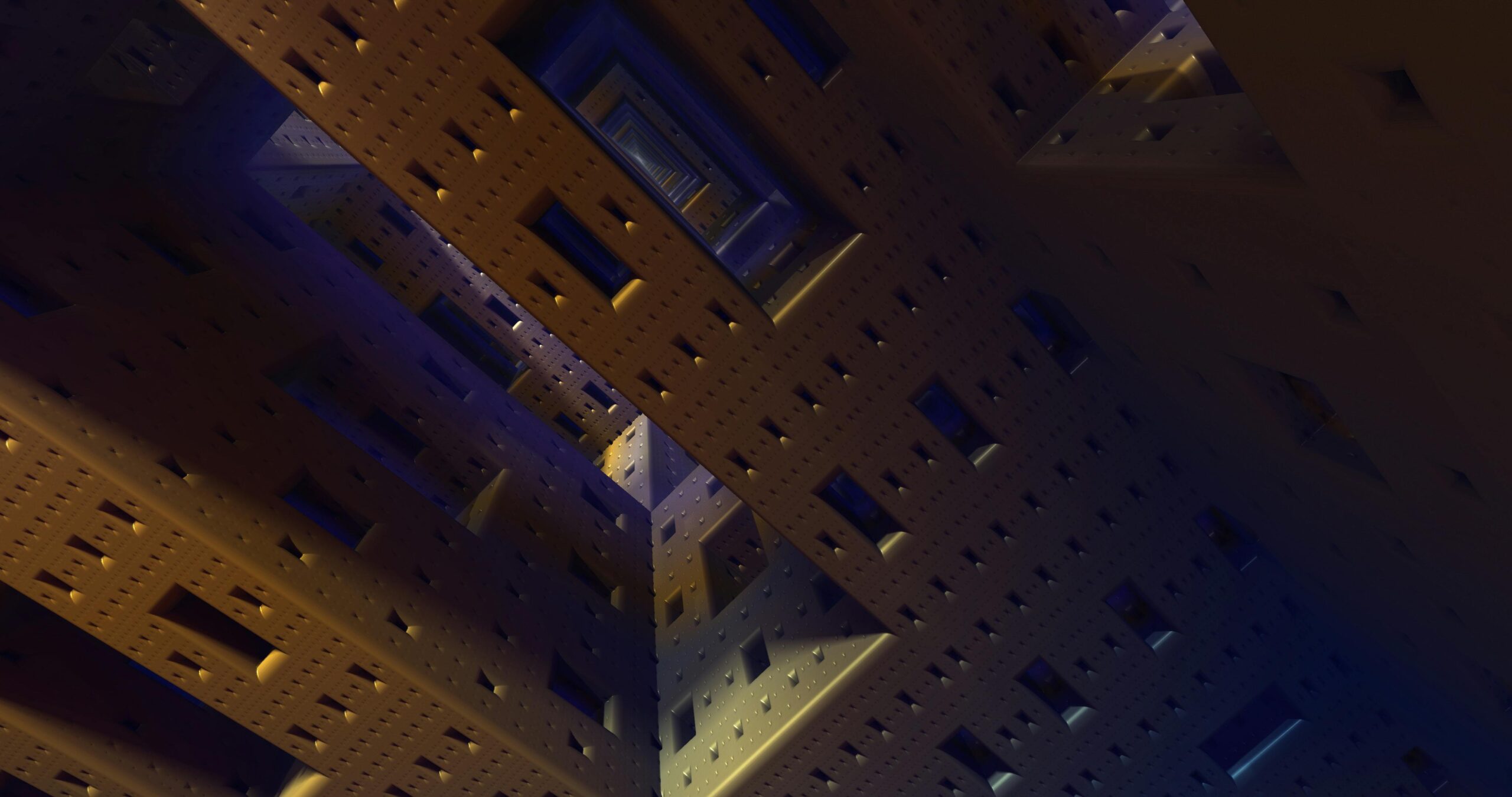
While classic fractals exist in two-dimensional complex planes, three-dimensional fractals like the Mandelbulb and Mandelbox create volumetric structures that can be explored from any angle. These 3D fractals require substantially more computational power but produce stunning results that blur the line between mathematical visualization and science fiction landscapes.
Rendering 3D fractals involves ray marching techniques where virtual rays traverse mathematical space, determining surface intersections through distance estimation algorithms. Artists can apply lighting models, textures, and camera effects, treating the fractal as a sculptural object in virtual space.
Animation: Fractals in Motion
Animating fractals adds temporal dimension to spatial complexity, creating hypnotic journeys through mathematical landscapes. Zoom sequences diving infinitely into Mandelbrot set details have become iconic, demonstrating the endless depth contained within bounded regions.
Parameter animation creates morphing effects where one fractal smoothly transforms into another, revealing the continuous relationships between different mathematical states. These animations often accompany music, with parameter changes synchronized to rhythm and melody, creating synesthetic experiences.
💡 The Philosophical Dimension: Infinity, Creativity, and Meaning
Algorithmic fractal art raises intriguing questions about creativity, authorship, and the nature of art itself. When an algorithm generates an image, who is the artist—the person who wrote the code, selected the parameters, or the mathematical process itself?
This question parallels broader discussions about generative art and artificial intelligence in creative fields. Fractal artists argue that their creative contribution lies in exploration, curation, and refinement—choosing which mathematical regions to showcase, how to render them, and what emotional or aesthetic qualities to emphasize.
The infinite nature of fractals also prompts philosophical reflection. Each fractal contains unlimited detail, with entirely unique regions existing at every scale. This mathematical infinity mirrors broader questions about the universe’s structure, the relationship between simplicity and complexity, and the boundaries of human comprehension.
🌟 The Community: Sharing and Evolving Together
Fractal art has cultivated a vibrant global community where enthusiasts share techniques, parameter files, custom formulas, and finished artworks. Online galleries, forums, and social media groups connect artists across continents, fostering collaborative learning and mutual inspiration.
Platforms like DeviantArt, Fractal Forums, and specialized fractal websites host extensive collections where artists showcase their work and provide technical details. Many fractal artists generously share their parameter files, allowing others to explore the same mathematical regions and learn advanced techniques through reverse-engineering.
Competitions and challenges within the community encourage experimentation and push creative boundaries. Theme-based contests, technique-specific challenges, and collaborative projects keep the art form evolving while maintaining welcoming environments for beginners.
Practical Applications: Beyond Aesthetic Beauty
While fractal art primarily serves aesthetic purposes, fractal algorithms find practical applications across numerous fields, demonstrating the utility of mathematical beauty.
Computer graphics extensively use fractal terrain generation for creating realistic landscapes in video games and films. Fractal compression algorithms can efficiently encode images by exploiting self-similarity, though newer methods have largely superseded them. Antenna design employs fractal patterns to create compact, multi-frequency receivers.
Medical imaging uses fractal analysis to characterize tissue structures, identify abnormalities, and quantify biological patterns. Financial markets exhibit fractal properties in price movements across different time scales, informing trading algorithms and risk assessment models.
Getting Started: Your First Steps into Fractal Creation ✨
Beginning your fractal art journey requires no special equipment—just curiosity and willingness to experiment. Start with free software like Mandelbulber, XaoS, or online fractal explorers that run directly in web browsers.
Initial exploration should focus on discovery rather than finished products. Navigate through fractal space, zoom into interesting areas, experiment with different color schemes, and observe how parameter changes affect the result. This playful exploration builds intuition about fractal behavior and develops your aesthetic sensibilities.
As comfort grows, study works by accomplished fractal artists. Analyze their compositions, color choices, and the mathematical regions they showcase. Many artists provide parameter files with their works, allowing you to explore the exact mathematical locations and understand their creative decisions.
Document your explorations by saving interesting coordinates and parameters. Build a personal library of favorite locations, color palettes, and techniques. This collection becomes an invaluable resource as your skills develop and your artistic vision matures.
The Endless Frontier: Future Directions in Fractal Art
Algorithmic fractal art continues evolving as computational power increases and new mathematical discoveries emerge. Real-time ray tracing enables interactive exploration of complex 3D fractals at unprecedented quality. Virtual reality applications offer immersive experiences where users can walk through fractal landscapes, experiencing mathematical beauty at human scale.
Machine learning integration presents intriguing possibilities, with neural networks trained to generate novel fractal variations or automatically discover aesthetically pleasing parameters. These AI-assisted tools might expand creative possibilities while raising new questions about artistic agency and authenticity.
The convergence of fractal algorithms with other generative art techniques creates hybrid forms that blend mathematical precision with organic unpredictability. Artists increasingly combine fractals with particle systems, cellular automata, and other algorithmic approaches, producing works that transcend traditional categorical boundaries.
As more people discover the joy of fractal creation through accessible software and educational resources, the community grows and diversifies. This expansion brings fresh perspectives, novel techniques, and innovative applications that keep pushing the boundaries of what’s possible within this mathematical art form.
Algorithmic fractal art represents more than beautiful images—it embodies a unique relationship between human creativity and mathematical truth, demonstrating how simple rules can generate infinite complexity, and how patient exploration can reveal hidden beauty within abstract systems. Whether you approach fractals as an artist, mathematician, programmer, or curious explorer, this journey into infinite creativity offers endless discoveries and profound satisfaction.
